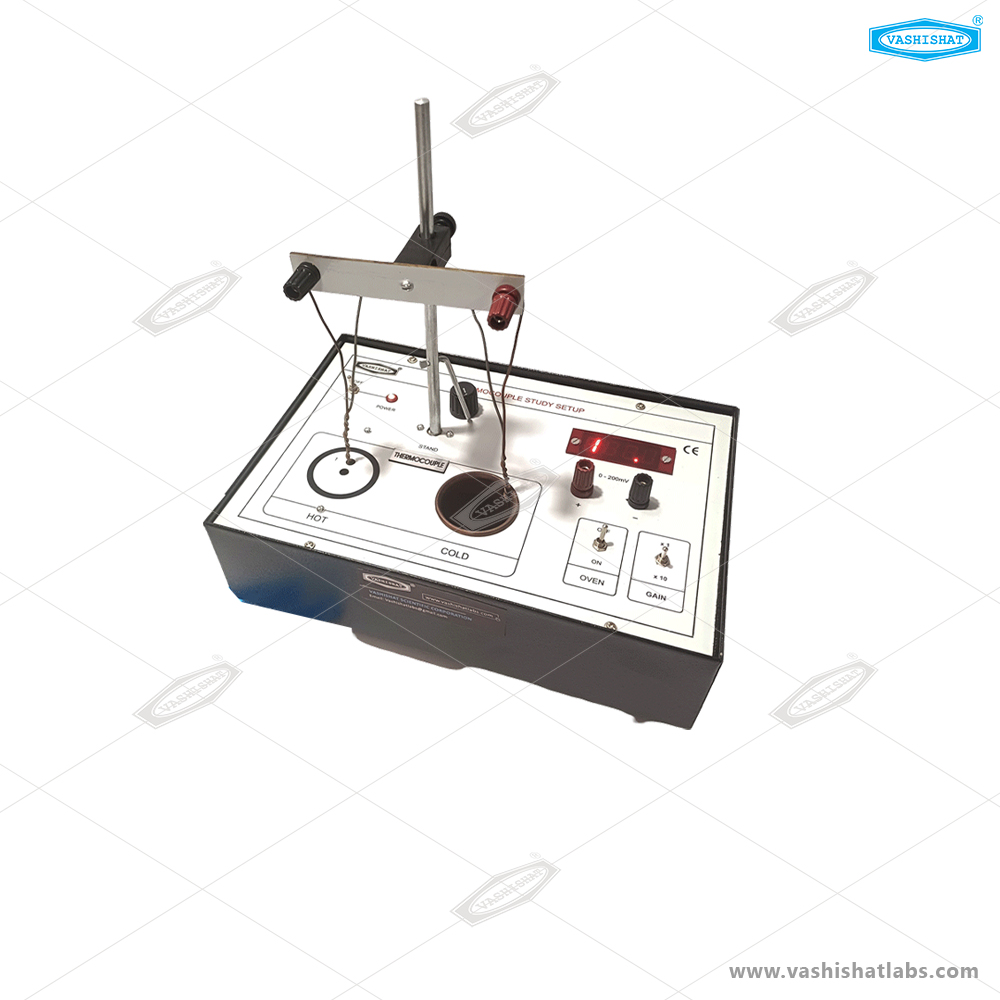
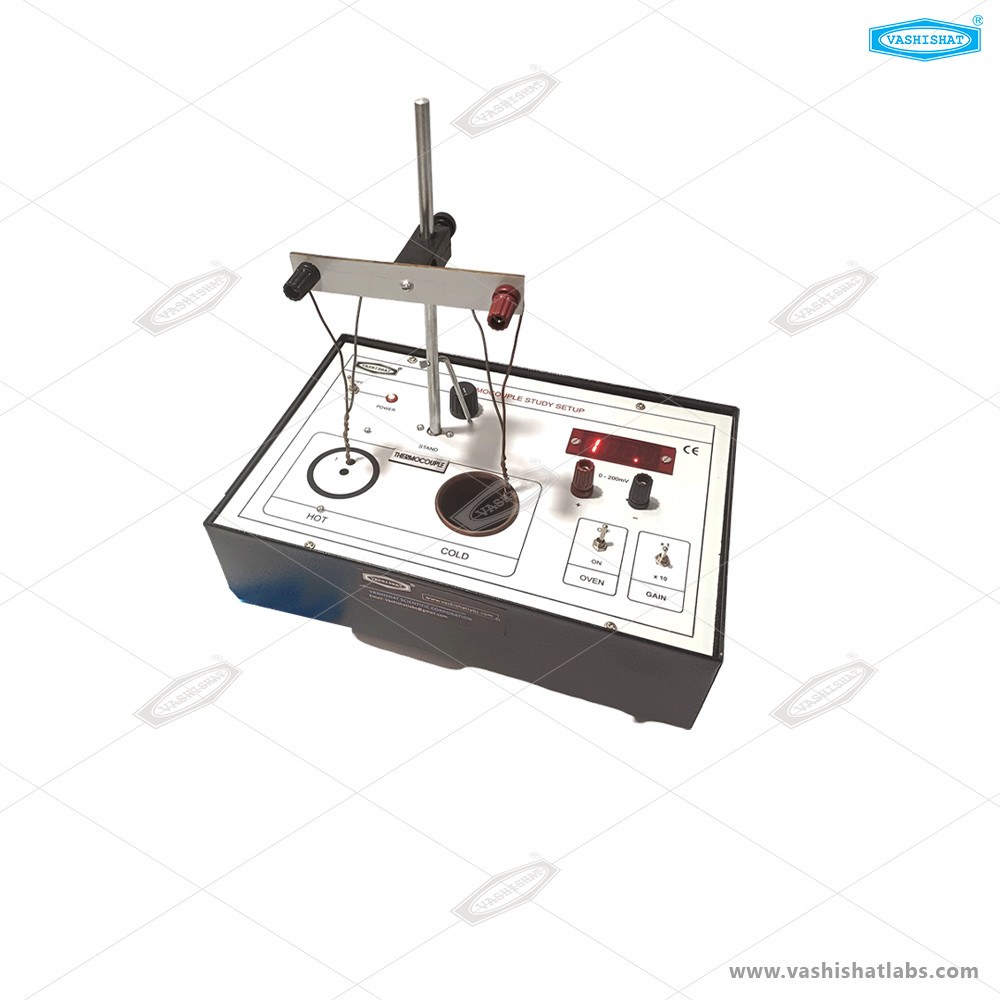
To study the variation of thermo electric E.M.F of a thermocouple with difference of temperature of its two junctions
Working Principle
The experiment is based on the Seebeck effect, which states that when two dissimilar metals form a closed circuit and their junctions are maintained at different temperatures, a thermoelectric EMF is produced. The magnitude of this EMF depends on the temperature difference between the hot and cold junctions and the nature of the metals used. By maintaining one junction at a fixed reference temperature and varying the temperature of the other junction, the corresponding EMF generated is measured. This allows the study of the relationship between thermoelectric EMF and temperature difference.
Theory
A thermocouple consists of two dissimilar metallic wires joined at two junctions. When the two junctions are maintained at different temperatures, a thermoelectric EMF is generated due to the Seebeck effect. The generated EMF is approximately proportional to the temperature difference between the junctions for small temperature ranges. Mathematically, the thermoelectric EMF can be expressed as a function of temperature difference. By measuring the EMF for different temperature differences and plotting a graph of EMF versus temperature difference, the thermoelectric characteristics of the thermocouple are studied. This experiment helps in understanding temperature measurement techniques and the practical application of thermocouples in thermal and industrial systems.
Have a catalog? Know what you would like to buy? Save time, enter item and quantities here, when you are finished click on the shopping cart button. You are ready to check out, it’s that quick.