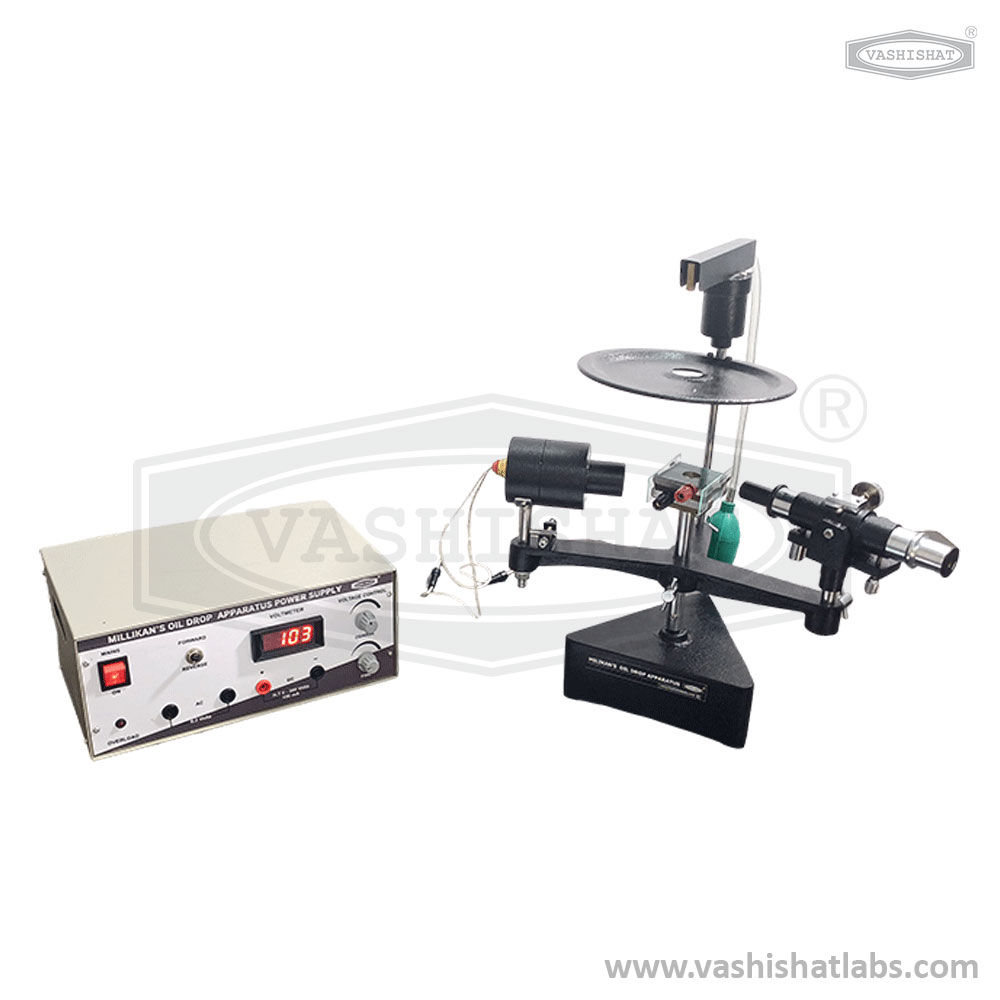
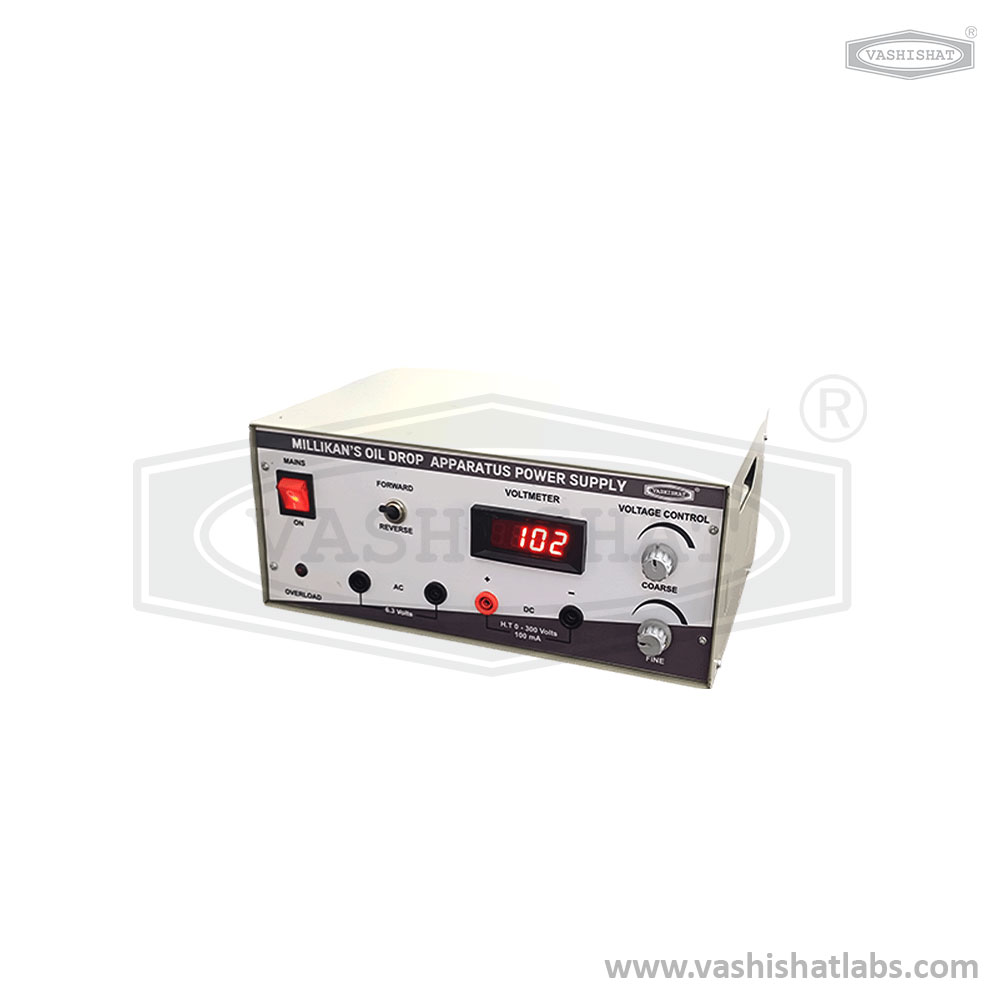
To determine the charge of an electron using Millikan’s oil drop apparatus
Working Principle – Millikan’s Oil Drop Experiment The working principle of Millikan’s oil drop experiment is based on the equilibrium of forces acting on a charged oil droplet suspended between two parallel metal plates. When a uniform electric field is applied, the electric force acting on the charged droplet can be adjusted to balance the gravitational force acting downward. By observing the motion of the oil droplet under gravity and under the applied electric field, the charge carried by the oil droplet is accurately calculated. Repeating the measurements for multiple droplets demonstrates that electric charge occurs only in discrete integral multiples of a fundamental unit, thereby confirming the quantization of electric charge.
Theory – Millikan’s Oil Drop Experiment In Millikan’s oil drop experiment, a fine mist of microscopic oil droplets is sprayed into the region between two horizontal, parallel metal plates. Some oil droplets acquire an electric charge due to frictional charging or ionization. In the absence of an electric field, a charged oil droplet falls with a constant terminal velocity, where the gravitational force is balanced by viscous drag, as described by Stokes’ law. Using this terminal velocity, the radius and effective mass of the oil droplet are determined.
When a uniform electric field is applied across the plates, an electrostatic force acts on the charged droplet. By carefully adjusting the applied voltage, the droplet can be made to rise, fall slowly, or remain suspended. When the droplet is held stationary, the electric force exactly balances the gravitational force, allowing precise calculation of the electric charge on the droplet. Repeated observations confirm that the measured charges are always integer multiples of a smallest value, which corresponds to the fundamental charge of an electron.
Have a catalog? Know what you would like to buy? Save time, enter item and quantities here, when you are finished click on the shopping cart button. You are ready to check out, it’s that quick.