
Principle and Working
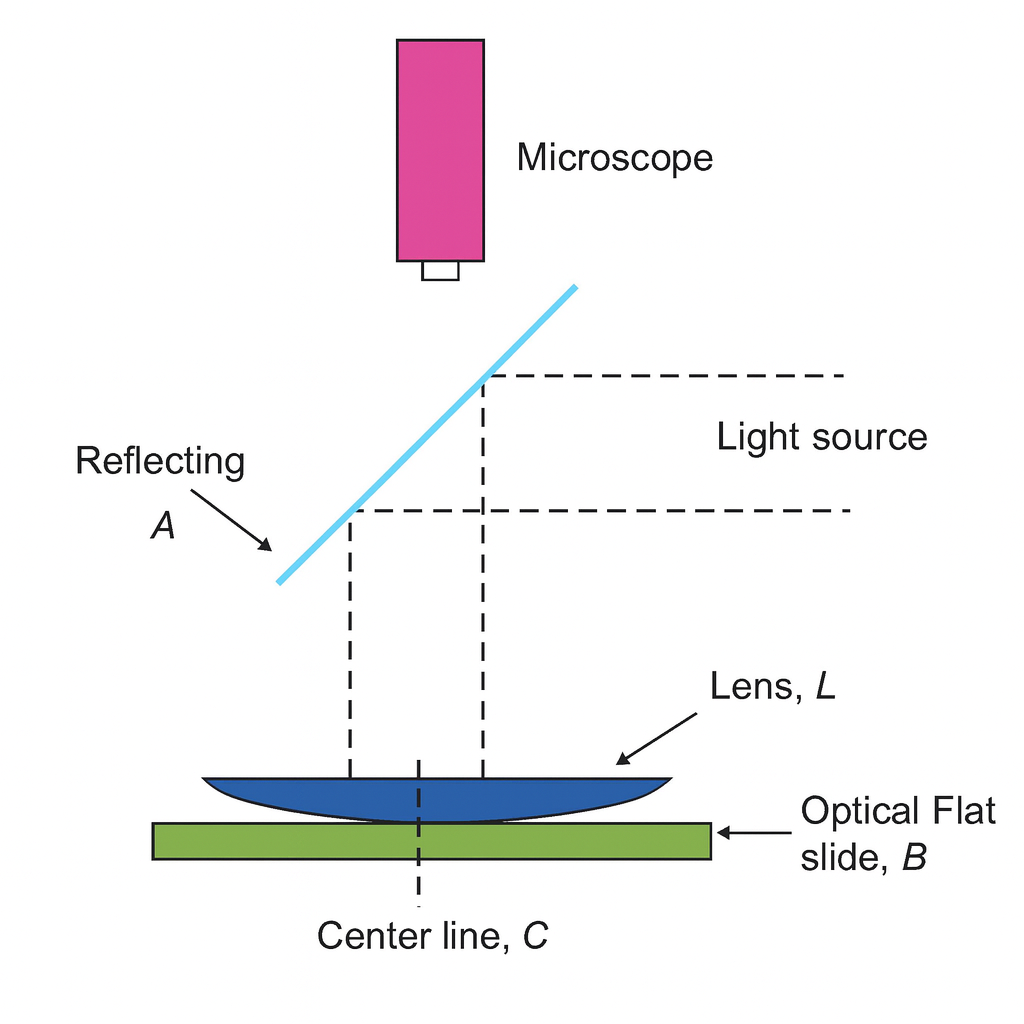
In Newton’s Rings, a plano-convex lens is placed with its convex surface in contact with an optically flat glass plate, creating a thin air film of varying thickness between the two surfaces. When monochromatic light from the sodium lamp is collimated and directed onto a 45° inclined glass plate, it reflects onto the plano-convex lens. The resulting interference between light reflected from the top and bottom surfaces of the air film produces concentric circular fringes known as Newton’s Rings.
By measuring the radii of these interference fringes with the microscope’s micrometer, the wavelength of the monochromatic sodium light can be accurately calculated.
Specifications
Micrometer: Least count 0.01 mm
Eyepiece: Ramsden 10X
Objective: 3X
Sodium Lamp: Inbuilt lamp housing
Construction: Rigid and durable metal cast body
Newton’s Ring Apparatus