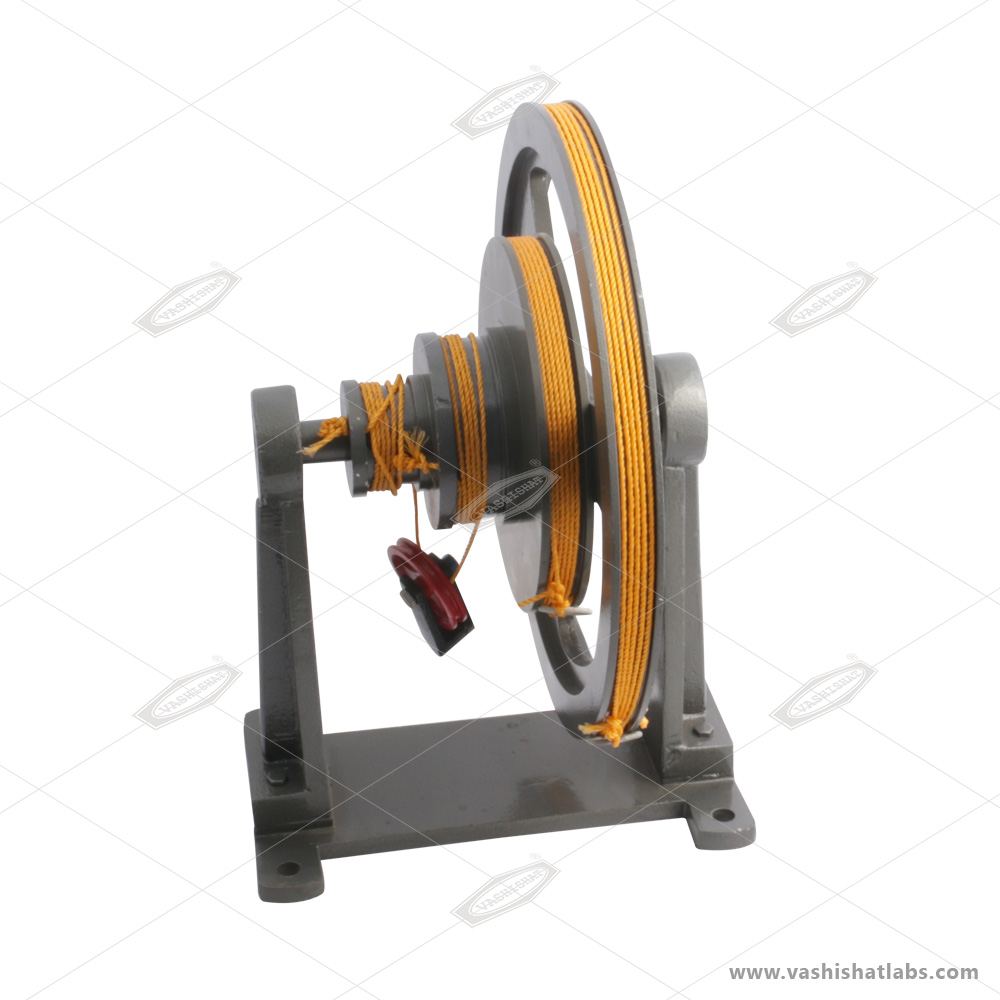

This Compound Wheel and Axle is a robust mechanics laboratory apparatus used to demonstrate the principles of mechanical advantage, velocity ratio, and efficiency in compound wheel-and-axle systems. It is designed to help students understand how different axle diameters affect effort, load movement, and transmission ratio.
The apparatus features a 350 mm diameter wheel fitted with a three-step axle having diameters of 200 mm, 100 mm, and 50 mm. This arrangement allows experiments with different transmission ratios and helps in comparing the performance of the system under varying conditions.
The complete assembly is mounted on low-friction ball bearings housed in sturdy iron brackets for smooth rotation. The base is provided with mounting holes for secure wall installation. Supplied complete with a snatch pulley block, cord, and hooks, but without weights.
Experimental Objectives
To demonstrate the working principle of a compound wheel and axle.
To determine the mechanical advantage of the apparatus.
To determine the velocity ratio of the compound wheel and axle system.
To study the efficiency of a simple machine.
To understand the relationship between load, effort, velocity ratio, and mechanical advantage.