
This Rigidity Apparatus – Searle’s Method is a specialized physics laboratory instrument used to study the elastic behavior of materials through torsional experiments. It is designed to help students determine important elastic constants such as Modulus of Rigidity, Young’s Modulus, and Poisson’s Ratio of a given test wire.
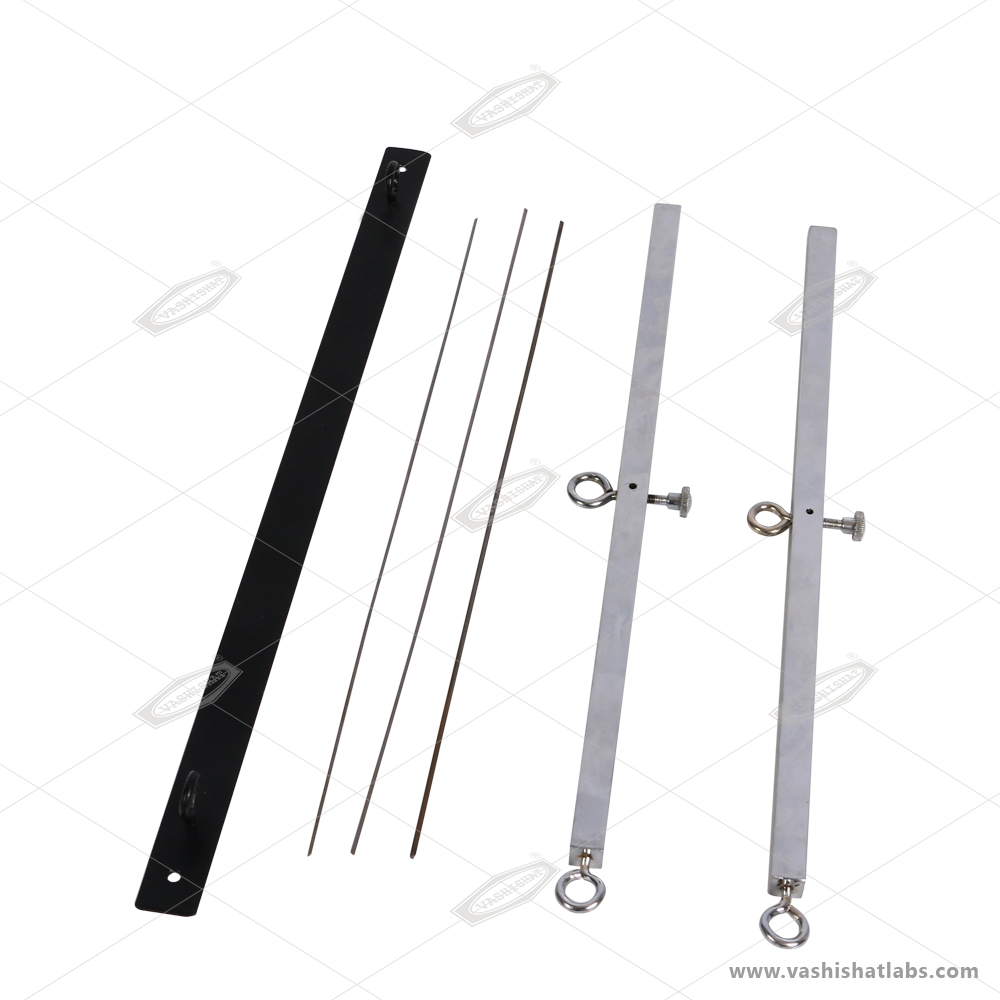
The apparatus includes two equal-length inertia bars, each approximately 30 cm long with a 12 mm square cross-section. Both bars are provided with centrally drilled holes for proper mounting of the test wire. Clamping screws are fitted to securely hold a test wire of approximately 30 cm length and 1 mm diameter during the experiment.
Supplied with three test wires and a ceiling bracket with hooks, this apparatus offers convenient suspension and reliable performance for practical experiments in schools, colleges, universities, and engineering laboratories.
Experimental Objectives
To determine the Modulus of Rigidity of the material of a given wire using Searle’s Method.
To determine Young’s Modulus of the test wire.
To determine Poisson’s Ratio of the material of the wire.
To study the elastic properties of materials under torsional conditions.